Showing posts with label card games. Show all posts

Tuesday, February 27, 2024

Learning from A Classroom Game

 All great deeds and all great thoughts have a ridiculous beginning. Great works are often born on a street corner or in a restaurant’s revolving door”

Albert Camus

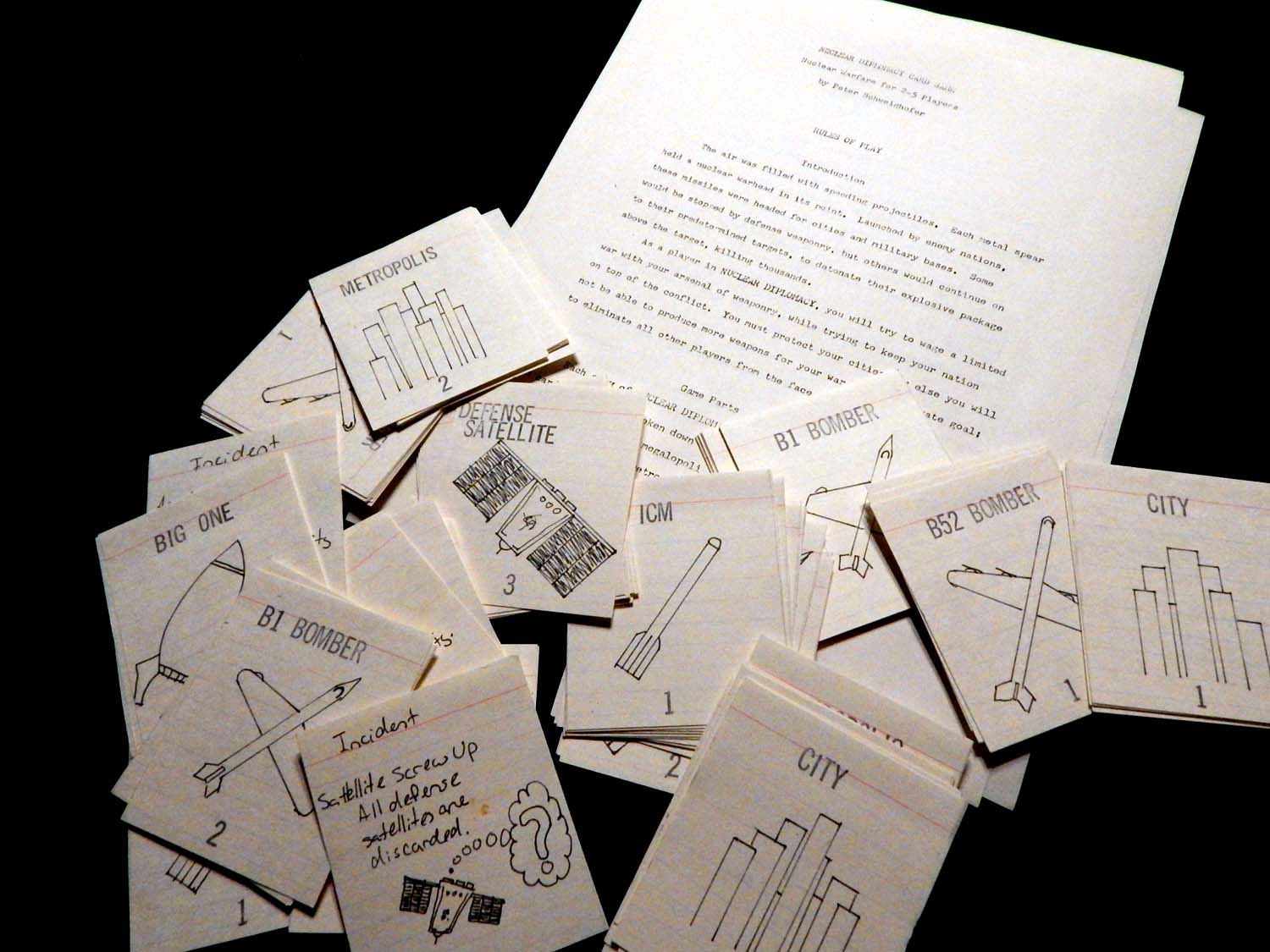
When I was in high school way back in the early-mid 1980s – and totally immersed in roleplaying games as well as a few wargames – I pursued an idea for a nuclear war themed card game. I’d never seen Flying Buffalo’s Nuclear War, though the advertisements for it in Dragon Magazine probably lurked in my subconscious. My junior-year English teacher encouraged me in my game-design endeavors, to the point where she asked me to prepare a master to photocopy and trim so everyone in the class could give it a try. Looking back on it all these years later, it reminds me of a few lessons about creativity, production, and a game’s intention; lessons I failed to realize at the time but issues with which I’ve contended throughout my involvement in the adventure game hobby.

Tuesday, October 4, 2016

Minecraft Card Game? Ideal for Families

We recently bought the Minecraft Card Game? for our son, the six year-old “Little Guy,” because he’s immersed himself in the Minecraft universe. I don’t pretend to know much about Minecraft; I’ve accepted it as one of those fads I’m aware of yet encourage my son to explore. At his insistence I bought Minecraft for his tablet and many of his first-grade friends are into it, so it’s his “thing” now (having set aside Star Wars, Doctor Who, and Godzilla for the time being). So he now wants any associated Minecraft toys and, when he saw it, the card game. I was skeptical at first, thinking I was just pandering to his fad de-jour, but upon playing it several times with our family, discovered the Minecraft Card Game? did a nice job of merging an interesting theme with easy yet engaging mechanics.


Tuesday, March 15, 2016

Star Wars Duels Redefines “War” Card Game

I recently picked up Star Wars Duels, a card game from Hasbro with an obviously popular theme, at the behest of the six year-old Little Guy, who saw it on sale at our grocery store and immediately wanted it to try for our weekly family game night. I’m not a huge fan of card games, though we have a number we enjoy because they’re right at the Little Guy’s level and work with engaging themes (particularly Godzilla Stomp and Otters). Star Wars Duels pleasantly fits into that category, combining modified “War” gameplay with colorful images of Star Wars characters kids love.

The 54-card deck comes with a rules flyer and a reference card for some of the symbols used in the game. They’re standard playing card-sized cards, though given the box size and the intended audience I somewhat expected slightly larger, more kid-friendly cards. Each card comes with a blue, red, or yellow border for the heroes, villains, and neutrals (mostly creatures); a full-color photograph of the character; their name; a card value from 1 to 10; and one or two symbols related to the character’s affiliation. The heroes and villains each have 23 cards, with 8 yellow cards devoted to neutrals. Card values seem a bit inconsistent, but vary from a standard playing card deck spread: 8 to 9 cards of the lower values (1–3); 4 to 7 cards of the middle values ( 4–6); and 3 to 4 cards of the highest values (7–10).


Tuesday, October 7, 2014

“War” Inspired Battlefield Card Game

I don’t know why the card game “War” has been on my mind lately. I played it a few times as a kid more to pass the time than anything else; but as an adult game designer I realize, much as game design luminary Greg Costikyan posited, it’s not much of a game considering the completely random elements and lack of player choice (to which variants only add small, limited degrees of strategy). It’s an odd enigma among games – if you want to even call it a “game” – yet it incorporates some game-like elements: drawing and playing cards, comparing card values, and collecting “tricks” used for scoring.

The 5 of Clubs helps reinforce the meager 4 of Diamonds.
This inexplicable fascination feeds off my general predilection for developing new game designs and for adapting them to themes I find interesting (usually rooted in historical periods). The attraction to a basic childhood pastime ties into my urge to create games accessible to both a young audience and newcomers to the adventure gaming hobby.

In examining what few rules the “game” of “War” has, several elements stand out that I like in gameplay: pitting cards against each other with the higher value winning; the escalation mechanic when two cards tie (in which additional cards are drawn, with the top ones revealed to break the tie, winner take all); and a clear scoring mechanic of the player with the most cards at game’s end wining. But I also notice several deficiencies related to the obvious lack of any player choice to affect the game’s outcome: players have no hand from which to choose particular cards; they have only one position to deploy them and one opponent to face on the field; and even when additional cards are drawn to break ties, the result still boils down to comparing two completely random card values. A little bit of casual internet research shows a frightening number of “War” variants exist, some offering more player choice and strategy than others.

Since I have a passing interest in wargames (as well as other adventure games) I sought to infuse the basic concepts of “War” with some elements of battlefield strategy, enabling some meaningful player choice along the way and creating an entirely new game with a military theme playable with a standard deck of cards.

Battle Lines

I’m calling my “War” inspired game Battle Lines since that perhaps best characterizes the game’s core mechanic. Like “War,” players begin by evenly dividing one deck of cards (with the jokers removed). Each turn they draw or “draw up” to a hand of four cards. From these they deploy three to their battle line, one on the left flank, one in center, and one on the right flank; each of these stands opposite a card the opponent deploys in similar fashion. This leaves one card in each player’s hand as a sort of “reserve.”

Players reveal all their cards on the battlefield, comparing cards matched up in the same locations: one’s left flank to the other’s right flank, the center cards against each other, and 0ne’s right flank to the other’s left flank. The highest card captures the lower card in each contest (with face cards valued at 11, 12, and 13 respectively, and aces worth 14). Before anyone takes cards on the flanks, the player with the lower card may play his reserve card and add its value to his card in the battle line; but this flanking reserve card must either have the same suit as one of the cards played to that location. For instance, Player A plays the four of diamonds on his left flank opposing the seven of clubs Player B deployed to his right flank; Player A needs to have a card with diamonds or clubs to reinforce and increase his total, presumably higher than the opponent’s card (like in the photo at the top of this post). Cards deployed and captured at each position go into the winner’s discard pile. Should any confrontations result in a tie, each card on the line returns to the respective player’s hand; reserve cards used to achieve tied values go into the discard pile of the player who deployed them. The next turn players draw enough cards from their deck to make a four-card hand (three cards if they didn’t deploy reserves, four if they did).

The game ends when one player’s deck runs out, resulting in one last deployment with the player possessing fewer cards deploying them last (possibly having battlefield positions without cards, which the opponent wins by default). Each player counts their discard pile; the one with more cards wins the battle.

There’s a little more room for strategy than in “War” itself. Players have to evaluate their four-card hand to determine what they want to play to the flanks, where the reserve card might help them. After players reveal cards on the battle line they have to determine if they want to play a flank card based on their own cards or those their opponent plays to his flanks. And both players must evaluate and try to second-guess their opponent’s general deployment strategy (if any) within the limited seven, eight, or nine turns enabled by the small deck sizes; does the opponent tend to place strong cards in the center, or does he have any rationale to playing certain cards to the flanks?

The only rule I’m waffling on is what to do with tied cards in a battlefield location. Right now I think it best for them to return to their respective players’ hands, giving opponents a glimpse of what might come into play next turn. I’ve considered keeping them on the battlefield but forcing players to deploy them to different, non-opposed positions.

I’ve modified a few ways certain mechanics in “War” work to better mold the game. Battle Lines still retains elements like splitting the deck evenly between two players, drawing cards from the top of that randomized deck, and resolving combat by comparing the values of two cards. The differences alter or evolve from parts of “War,” particularly using a discard pile to determine the winner instead of feeding captured and used cards back into the active draw deck, deploying several cards at once against matched opponent cards, and using the extra “reserve” card to sway individual battlefield contests in one player’s favor.

So that’s my “War” inspired card game you can run with a standard deck of playing cards. Give it a try, offer some feedback (see the “Comments” boilerplate below...) and I’ll see if it deserves some revision and publication in some form or another, just for fun.

Comments....
Want to offer feedback? Start a civilized discussion? Share a link to this blog entry on Google+ and tag me (+Peter Schweighofer) to comment.

Tuesday, May 6, 2014

I Love Killing Doctor Lucky

I recently received a Kickstarter campaign copy of Cheapass GamesGet Lucky, the card game based on its popular Kill Doctor Lucky board game. The original game won the Origins Award for Best Abstract Board Game the year after its first release, and still remains available as a free PDF print-and-play download at the generous Cheapass Games website (though you can always leave a donation “tip” to show your appreciation). Seeing the card game version reminded me how much I’ve enjoyed killing Doctor Lucky over the years and made me happy to see many familiar game mechanic themes distilled into a compact yet strategically deep play experience.

I can’t recall where I picked up my old “Director’s Cut” copy of Kill Doctor Lucky. It was, like many Cheapass Games of the time, packaged in a cardboard mailer box with a few separated cardstock map sheets and a host of hand-trimmed cards; players had to supply their own pawns and one for Doctor Lucky, a hallmark of the company that created games playable with pawns, dice, and other bits cannibalized from other games in players’ homes.

The original mechanics revolve around each player wandering through Doctor Lucky’s mansion, following the hapless fellow as he makes his way from one numbered room to the next. Players could, depending on available cards, move themselves or Doctor Lucky several rooms and hallways or to a specific room, search for items to aid their murder attempt (draw a card), or attempt to murder him. These attempts required no witnesses with a line-of-sight view into the room where the dastardly deed might take place, an extremely difficult feat particularly in games with many players; while the active player could use a weapon to increase their chances of success, others could play “failure” cards to stop this particular attempt with the hopes of killing Doctor Lucky themselves on a subsequent turn. While gameplay was extremely engaging – with players jockeying their pawns and Doctor Lucky around the board and nobody really certain who had the best chance to win until the very end – it became very frustrating setting up the perfect no-witness meeting with the old fellow only to have everyone else pitch in to ensure failure. With a host of players the game also seemed to drag on until someone made a murder attempt after everyone else had spent their cards canceling earlier tries. (An optional “spite” rule – made a regular rule in the deluxe edition – helped escalate the action by giving players a token for each failed attempt, which they could use as a +1 bonus on subsequent attempt or play as 1-value failure pieces to cancel someone else’s attempt.) Overall, though, the game has some wonderfully intuitive and intriguing mechanics, particularly the one where any player in a room into which Doctor Lucky moves immediately takes their turn, skipping other players in the normal sequence.

At some point in the past few years I bought the deluxe version of Kill Doctor Lucky produced by Paizo Publishing. While it’s nice to have cardstock pawns with stands for each potential murderer, Doctor Lucky, and his dog, as well as professionally produced cards, the wonderfully rendered, full-color, top-down map-board of Doctor Lucky’s mansion is so graphically detailed it’s sometimes difficult to determine which doorways lead where. Still, it’s good to have a quality, professionally produced game version of a beloved basic-publishing classic.

Cheapass Games also produced a “prequel” game in the Doctor Lucky series – with Paizo later releasing a slick deluxe version – that cleverly reverses many of the Kill Doctor Lucky rules and adds a keen escalation mechanic to keep the game from running too long. Save Doctor Lucky includes four smaller, elongated game boards depicting the decks of an ocean liner much like the RMS Titanic (complete with iceberg...). Players must save Doctor Lucky from the sinking ship so they can savor their intricate plots to murder him later. The game still uses similar movement mechanics as the original game, though “move” cards frequently offer the option of moving player pawns or Doctor Lucky a certain number of rooms or sending one or the other off to a particular location (rather than the separate “move” or “location” cards of the earlier game). In a suitable twist the draw deck is divided into four, each placed next to one of the ship's deck boards; players draw cards from the lowest deck, so when that deck of cards disappears, the ocean liner’s actual deck board also goes, sending any player pawns and Doctor Lucky up to the next viable deck. When all four decks are exhausted the ship sinks, the game ends, and everyone loses.

Cheapass Games recently ran a Kickstarter campaign to release Get Lucky, another game in the Doctor Lucky line. This card version artfully distills the essence of the original game, leaving the board behind and condensing murder weapons, locations, failures, and spite mechanics onto a 72-card deck. Instead of moving from one numbered location to another, the Doctor Lucky pawn (included) moves between numbered character cards. Players choose several characters who can try murdering the old fellow when he’s on their card (and players can trade out character cards as a turn action). Players can attach “upgrades” – motive, weapon, and opportunity cards – to their character cards for a +1 bonus in murder attempts; pairing one of those cards with the matching character card (indicated by similar numbers on the cards) gains a +2 bonus. Foiling murder attempts uses several new mechanics in the spirit of earlier games. Instead of playing separate “failure” cards, players can use motive, opportunity, and weapon cards that have one or two “luck” icons (four-leafed clovers) in the margin, the number of clovers indicating the value of the “failure” card. Anyone playing an upgrade card with a number matching that of the character attempting the murder automatically foils the attempt. Twelve “spite” cards also offer one-point failure options; in a nice escalating twist on past mechanics, spite cards detract their value from a character’s future murder attempts. All these options in the “failure” mechanic force players to make a choice: do they burn through their cards to stop a murder attempt now, or do they save choice cards to use later? And when the deck is gone, the discard pile isn’t shuffled and re-used, giving the game a shorter play time and an increasingly desperate tone as players scramble to get Doctor Lucky.

Cheapass Games and James Ernest – the creative genius behind many of its offerings – have a rich history of offering both affordable games where players provide their own pieces and entirely free print-and-play games. The company website offers links to read about and buy current titles, but provides a host of excellent games for free PDF download for those willing to produce their own print-and-play copies (for those seeking guidance in preparing such materials, James Earnest has even produced several instructional videos about cutting game cards and making tiles). Several games stand out from the host of free offerings, particularly the popular Button Men (with intriguing dice mechanics), Light Speed, Unexploded Cow, Take-Back-Toe – winner of Daniel Solis’ Thousand Year Game Design Challenge – and, of course, the free PDF download for the original, Origins Award-winning Kill Doctor Lucky. If you like the free materials, leave a “tip” in the form of a donation through the website.

The company continues developing and funding new games (primarily through Kickstarter) that incorporate intriguing game mechanics and engaging (if not outright humorous) themes. Cheapass Games might not have the same marketplace visibility and prominence in the collective consciousness of gamers as more massive adventure gaming companies, but it certainly deserves greater recognition for its excellent titles and generosity with free games.

Comments....
Want to offer feedback? Start a civilized discussion? Share a link to this blog entry on Google+ and tag me (+Peter Schweighofer) to comment.


Tuesday, February 18, 2014

Sergeants Card-Driven Miniatures Rules

Sergeants Card-Driven Miniatures Rules

I recently had the opportunity to play in several beginner-friendly games of the Sergeants Miniatures Game from Lost Battalion Games and – despite a steep learning curve for what looks like a huge board game with cards and minis – really enjoyed the World War II squad-level action driven by some innovative card mechanics.

Sergeants incorporates elements of a board game, particularly a modular board of squares that recombine to form various map boards depicting typical Normandy terrain. It uses pre-painted 20mm miniatures of German and Allied soldiers much like a historical miniatures game, although each has a base with an individually named and numbered dog-tag. Each soldier comes with a single stat card depicting its abilities (movement, ability to rally pinned comrades, range for spotting and shooting enemy soldiers, victory points) plus seven cards keyed to that soldier for resolving randomized elements within the game. These cards form the core of the Sergeants game.

Card-driven mechanics aren’t new to board or wargames – take a look at Richard Borg’s incredible Memoir ’44 or Collins Epic Wargames’ Spearpoint 1943 – but using cards with different sectors of game information for several mechanics within the game remains the central concept behind Sergeants.

In preparing for a game each player builds a squad based on soldiers’ victory points and extra points for special equipment and ordnance. The average point build used in our demo game gave each player a squad of six to eight soldiers. Once players select soldiers they set aside the stat cards for future reference and shuffle all the soldiers’ other cards together into a huge “action” deck.

Cards from the action deck serve numerous functions in resolving operations during the game:

* Stats on players’ NCO cards determine how many action cards they draw each turn, which offer a variety of “orders” – look, hide, move, shoot – given to a variable number of soldiers as listed on the card. Each turn players also draw three “story” cards from a common deck with pairs of matching actions (“move then look” or “shoot then hide,” for instance) that determine permissible actions during each of a turn’s three phases. The more action cards in a player’s hand, the greater the range of options they have. (And if a player loses an NCO in combat, he also loses the cards he allows them to draw each turn....)

* A dog-tag graphic on each card not only denotes from which soldier’s card-set it comes, but allows that soldier to take the associated action again or in addition to the number of soldiers listed who receive that order.

* Some cards include a blue or white “narrator box” with additional instructions, such as ordering the named soldier to move a certain way (toward or away from an enemy, toward a structure), make an attack, or even become visible to enemy units! White boxes remain optional (and are usually beneficial) while blue boxes are mandatory. These not only add some personal idiosyncrasies for the individual soldiers but force players to choose between the actions and numbers of soldiers activated on these cards or other, non-narrator cards.

* A red box lists and determines “hit checks” for various attacks at long, short, close, and blast range, such as “Long: Miss” or “Close: Hit.” Each time a soldier attacks he draws the top card from his action deck and checks the appropriate ranged attack: a “hit” result causes the target to draw from his own action deck....

* The lower right corner contains one of four damage results a target may receive if an attacker scores a hit: zip (near miss, no penalties), pin (pinned down, all soldier stats are halved), wound (soldier stat cards flipped to show reduced wounded stats), or killed. Wounded soldiers taking another wound are killed. These results are used differently in grenade attacks and are also used in a slightly different way in close combat.

(I will freely admit I’m no fan of the actual artwork on the cards; I found it distracting at best. While I understand the urge to tie cards into individual soldiers within the game, the overall functionality of the cards might have been better served with a more neutral image and larger game-relevant information. I also admit that artwork remains an extremely subjective issue and that the designers have no obligation to satisfy my particular artistic tastes.)

This is an extremely simplified overview of the multiple uses of cards in the Sergeants game; the interaction of cards, soldier figures, and the board makes for some engaging, squad-level gameplay, although I’ll admit the learning curve remains steep.

Squad-Level Play

Some folks might like the grand strategic action of the Axis & Allies boardgame or the battlefield simulation of Memoir ’44; others might prefer more tactical action like that offered by Spearpoint 1943 (I’ve featured a number of these games before). Sergeants offers a very focused play experience of squad-level infantry operations in World War II, with each player commanding a handful of individually named soldiers with variable abilities, including foibles exhibited through mandatory blue narrator boxes.

This requires a solid investment in leaning the rules (aside from a financial investment in the game itself), but rewards players with a very focused experience. Aside from managing only a handful of soldiers in a squad, choosing orders and action cards to maximize their impact on the battlefield, players identify more with individual, named soldiers than simple, anonymous “game pieces.” It helps that each soldier has specific stats different from others of the same rank; giving named soldiers an extra action when playing one of their cards makes players pay attention where they deploy different soldiers.

At first my own inability to view soldiers as individuals put me at a disadvantage, a clear demonstration of the steep learning curve I experienced with the rules. In my effort to move a core group forward and a flanking group off to one side, I gradually realized my senior NCO was a terrible shot (very limited range) and I’d inadvertently left my most powerful piece of firepower – the guy carrying the MG-42 machine gun – way in the rear of the group and conveniently at a worse range to attack enemy soldiers. In the second game I played I made sure the guy with the MG-42 was well placed in cover next to a soldier with a high enough range he might as well have been a sniper; the guys with good throwing ranges went off down the flank to close with enemy troops and later delivered crippling grenade attacks; my senior NCO stayed in the back in good cover so he didn’t have to expose himself to enemy fire when shooting at poor ranges.

I particularly enjoyed my view of enemy soldiers. Each painted miniature on the opposing side was also an individual – some NCOs, others armed with certain weapons – and I had no visual idea which ones were the better targets. It wasn’t even easy to recall which ones had particularly effective weapons or ranges unless I paid attention to the other players measuring ranges and consulting their own soldier cards. This provided a very realistic sense of a skirmish beyond what other miniature wargames and board games offer.

Other Banes & Boons

The Sergeants game demonstrated several key gameplay elements that stood out beyond the card mechanics; it also presented a few drawbacks one might overlook.

Besides the option to point-build individual squads (and that’s before considering any of the add-ons for soldiers, squads, and terrain noted below...), the ability to rearrange the “puzzle-piece” board for different scenarios gives Sergeants fantastic replay value. Each five-inch by five-inch square terrain piece (double that for “landmark” pieces) has puzzle-like tabs and indentations to fit with all the other pieces. Since the pieces are double-sided, this enables the game to present a host of terrain options and arrangements.

Each tile displays action modifier information right on the tile, making calculating ranges for moving, looking, hiding, and shooting easier. Although movement relies on measuring inches, other actions measure range by terrain tiles (with larger landmark tiles counting as two). When line of sight between soldiers for spotting and shooting cuts across several square tiles diagonally, those tiles and their modifiers count as well. This sometimes led to some debate at the game table about whether or not a line nicked a tile corner, a small issue considering the utility of having terrain modifiers listed on the terrain itself.
At least to my particularly frugal finances, the Sergeants game has a high price to buy into a base set – $89.95 for either Day of Days featuring American paratroopers or Red Devils with British paratroopers – not to mention pricey yet great-looking add-ons, from punch-out, three-dimensional terrain and new terrain tile sets to extra soldiers, complete with pre-painted minis and card sets. That’s not to say the basic game set isn’t packed with amazing components – one can’t argue with re arrangeable map tiles, a host of cards, markers for spotted and pinned soldiers, and pre-painted miniatures – but it represents a high buy-in for a hybrid board/miniatures game with cards. It’s certainly what some might call a “boutique” game that delivers a rather unique play experience particularly satisfying for gamers interested in World War II.

Perhaps the best way to try Sergeants and see if the investment’s worthwhile is to find a regional convention, game store, or gaming group where a Sergeants fan offers a demonstration. I lucked out in finding several games at a regional wargaming convention. I had the pleasure of participating in two games run by Jason Williams, who ran the Sergeants demo and the more involved game I played at Williamsburg Muster 2014. Despite what for me was a steep learning curve with the rules, he did a fantastic job of explaining the essentials and patiently shepherding us through various gameplay issues as they evolved on the board.

Overall I’d have to admit I was really pleased with the game experience Sergeants offered. If it weren’t for the high price tag for even just the base set (which could occupy me with different terrain and objective scenarios for a while) I’d dive right into it to satisfy my interest in World War II game action.

Comments....

Want to offer feedback? Start a civilized discussion? Share a link to this blog entry on Google+ and tag me (+Peter Schweighofer) to comment.