“History is the interpretation of the significance that the past has for us.”
— Johan Huizinga
![]() |
| Papercraft Romans awaiting a playtest battle with Germanic tribesmen. |
“History is the interpretation of the significance that the past has for us.”
— Johan Huizinga
![]() |
| Papercraft Romans awaiting a playtest battle with Germanic tribesmen. |
“If one does not know to which port one is sailing, no wind is favorable.”
— Seneca
I’ve dabbled in many historical wargaming periods over the years. The Age of Sail remains one for which I’ve never really found an accessible game — in both cost and rules — until now. Feral Wizard’s Battle Box: Age of Sail promises to deliver an intuitive game with plenty of tactical choices in a small package (much like its previous game, Battle Box: Napoleonic Wars). The game ran a successful Kickstarter back in the spring and should deliver physical components by the end of the year...but backers received the print-and-play component files when the campaign ended. So I printed out some cards and rules and played a few battles using my craft store sailing ships and my large-hex light-blue ocean canvas. After a few games to help me grasp the mechanics and strategies I found it offered a host of player choices to add depth to what seems on the surface a basic Age of Sail game.“The creation of something new is not accomplished by the intellect but by the play instinct acting from inner necessity. The creative mind plays with the objects it loves.”
— Carl Jung
The times constantly change, more so, it seems, in a volatile capitalist society with a general government administrative “policy” of instability, uncertainty, and chaos. We fear change. Even at the craft store. Over the years, and certainly more recently, I’ve noticed my usually reliable stable of craft stores gradually shift away from providing plentiful resources for various adventure gaming hobby endeavors. One expects prices to increase over time, though not quite the jump we’ve seen recently. But the stock seems to ebb and flow depending on fads in the crafting hobby, predicted on customers’ purchasing habits and what influencers deem is fashionable at the moment. Which inevitably means gamers are paying more and finding fewer game resources at craft stores. I suppose I will grudgingly get used to it, venting, as I sometimes do, here at Hobby Games Recce.“Fathers, both you and the English are white, we live in a Country between; therefore the Land belongs to neither one nor t’other.”
— Chief Tanaghrisson
![]() |
| French and Indian War provincial militia re-enactors march forth at Fort Frederick. |
“It’s not what you look at that matters, it’s what you see.”
— Henry David Thoreau
I’ve enjoyed many of John Curry’s volumes in his History of Wargames Project, from republication of early wargame rules and historical wargames used for training and analysis to treatises on matrix games and other serious wargaming. I recently acquired one that had previously eluded me, Joseph Morschauser’s How to Play War Games in Miniature: A Forgotten Wargaming Pioneer: Early Wargames Vol. 3. I was initially lured to it by the claim it included an introduction of a gridded play surface into miniature wargaming, but I pleasantly found it filled with intuitive, concise rules, options for basing, and overall solid advice for miniature wargaming newcomers just as relevant and inspiring as when it was first published more than 50 years ago. It was a refreshing affirmation of many miniature wargaming elements I’ve come to enjoy over the years: concise simplicity; based units; flexibility between open battlefield and gridded surface; flexibility between eliminating units or keeping a roster for a multiple hit system; and an overall informative and welcoming approach to hobby.
“A toy is seen both as a bauble and as an intellectual machine.”
— Brian Sutton-Smith
![]() |
| Ranks of paper minis march across the Great Bridge to disperse rebels. |
“I have but one lamp by which my feet are guided, and that is the lamp of experience.”
— Patrick Henry
![]() |
| Painting by Glenn Moore depicting the British attack on the American breastworks at the Battle of Great Bridge. |
“Human history becomes more and more a race between education and catastrophe.”
— H.G. Wells
One of the perks of my time working at West End Games was going along with the sales director to the GAMA trade shows to promote our game lines, notably the Star Wars Roleplaying Game. The trade show has changed a great deal over the years, but way back then exhibitors often chummed around with each other (also promoting their games) and traded product or gave away promotional items. Much of the “loot” I brought back I shared with colleagues (primarily dice), but a few I kept. On one trip to the GAMA trade show Osprey Publishing was celebrating its 25th anniversary; the promotional item staff gave out was a gorgeous, hardcover Osprey Illustrated Military Diary 1997. I never wrote in it. But it inspired me to explore historical periods and conflicts beyond what interested me at the time...and, as my wargaming hobby has expanded over the years, it’s tempted me with a historical game challenge: to run a game every week associated with a timely event.I have long admired the amazing graphic design behind the Osprey military history books. They often rely on primary photographs and original maps, but the highlight for me comes from the amazing original artwork depicting combatants, their equipment and uniforms, and the actions they fought. They’ve informed several of my historically based roleplaying game projects and have helped me research numerous elements for miniature wargames.
“On the 27th in the morning the troops quitted Danbury, and met with little opposition until they came near to Ridgefield, which was occupied by Gen. Arnold.”
— General William Howe
![]() |
| James Sharp's "A Skirmish in America" (1780). |
“Size matters not.”
— Yoda
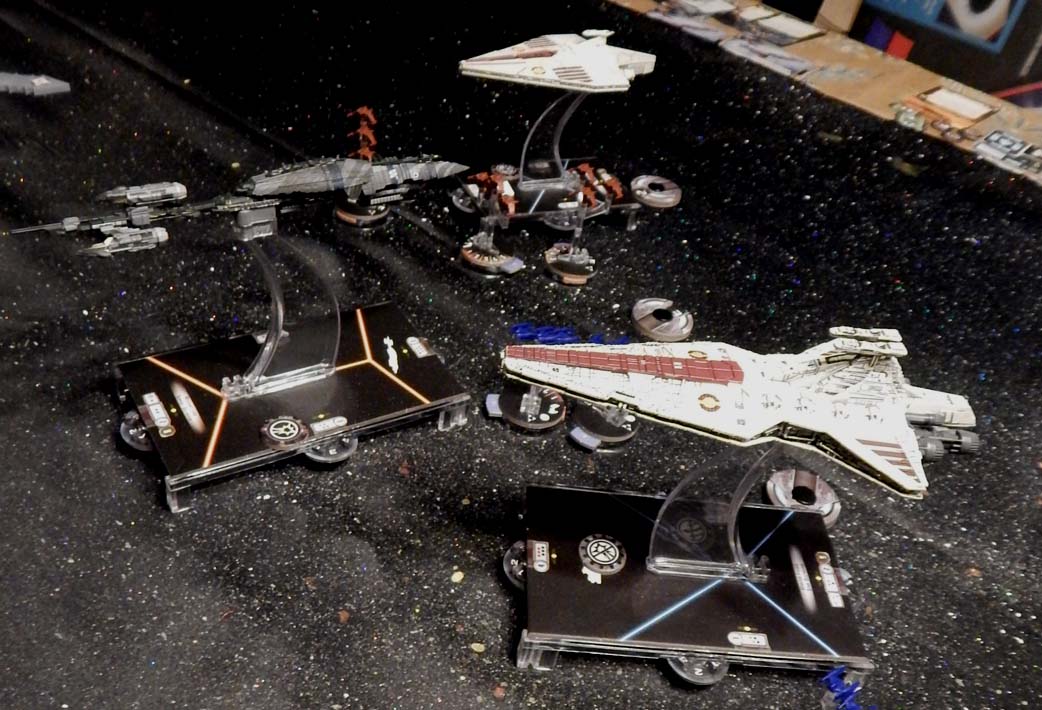
My son and I have been playing some Star Trek: Attack Wing scenarios recently, part of his exploration of the wide-ranging Star Trek franchise. In our past gaming endeavors we’ve indulged in Star Wars gaming, too (yet another franchise we love), including the X-wing Miniatures Game and Star Wars: Armada. Over the years we’ve managed to acquire fleets for those games to play engagements that catered to our interests as fans. While X-wing deals with fighter squadrons, Attack Wing and Armada feature massive capital ships. Although based on the foundations of the “FligthPath” system used in X-wing (and licensed for Attack Wing), the capital ships games play very differently from each other. While Attack Wing sticks closer to X-wing, Armada makes many adaptations to accommodate the larger ships, becoming a different game with similarities to its forebear. They’re both enjoyable games with solid systems for commanding capital ships in their respective fictional universes. After playing each for a while — and more recently enjoying our exploits with Attack Wing — I find, in the long term, I like Attack Wing more.“It is possible to commit no errors and still lose. That is not a weakness. That is life.”
— Captain Jean-Luc Picard
| Kirk and Khan pass nearby, trading shots, in a Star Trek: Attack Wing game. |
“The creation of something new is not accomplished by the intellect but by the play instinct acting from inner necessity. The creative mind plays with the objects it loves.”
– Carl Jung
At long last I finally released my latest game project this week. Skirmish Kids is a wargame with a low figure count, small play surface (compared to most miniature wargames), and basic core rules to which one can add a host of options to give the game more tactical depth. It includes a host of notes for using it for historical scenarios as well as a few more fantastic genres. You can find it in full-color PDF at both my Itch.io and Wargame Vault online storefronts and in print in black-and-white at Lulu and, a first for me, places like Amazon. Skirmish Kids is the culmination of a long interest in this kind of wargaming and years of tinkering to present rules and options at a level kids and newcomers to the hobby can understand and embrace.
“My failures have been errors in judgment, not of intent.”
— Ulysses S. Grant
At the beginning of this summer, as I evaluated my current gaming activities and future purchases, I made a resolution not to purchase any gaming miniatures that required painting. I have a long list of minis to paint (grognards often call it “The Pile of Shame”), some from ages ago, some more recently acquired. So I thought I’d try making a concerted effort to avoid purchasing anything I needed to paint, along with an effort to paint more regularly. Oh, I managed for a bit. I bought some old pre-painted plastic Lord of the Rings tradeable miniatures to rebase and use for Skirmish Kids playtesting and photos. But then I ran into an occasional and irresistible dilemma: the purchase of opportunity...those must-have items you might not find again or might forget about later. And after that, well, my resolve quickly faded.
“Success lasts only three seconds. After that, you’re the same as you were before you had it.”
— Robert Shaw
My recent missive on print magazines — particularly my efforts to clip the most relevant articles from years of WWII History — reminded me how much I liked Avalon Hill’s Axis & Allies Miniatures game years ago. (Mark Painter’s nose-art-inspired advertising artwork also reminded me how much I enjoyed the game.) I bought into it when it released in 2005 and purchased occasional booster packs for the original and subsequent sets. Using the point system to create forces consumed most of my time, as I imagine it would for any collectible game where one builds a deck or combat unit. I mostly engaged in solitaire play, commanding each side in turn. I don’t recall much about the mechanics, but I remember I liked numerous aspects of the game; though ultimately the randomized booster packs necessary to maintain the collectible aspect became untenable. Like many games, it’s come and gone, forgotten after the initial buzz and now difficult to find, either in the original starter sets and booster packs or as single figures with cards on the secondary market.My son and I just got back from a very positive game convention experience – our first together since the seemingly mythical “Before Times” prior to the covid-19 pandemic – and while I’m unpacking things I’m keeping in mind games that engaged him as well as considering a comfy pile of games I urgently want to play when I find the time and/or a willing opponent. Some call this the “Shelf of Shame,” though rather than “shame” I view it as “opportunity.” Have I read all the books in my extensive personal library? No. But they’re available if the urge strikes me or I need to explore some references for a project. I view games the same way. And, of course, the pile isn’t that backlog of hobby game projects (painting minis, working on terrain, etc.) or the other backlog of game design/writing projects. But I like to strike while the iron is hot to engage my son through the intersection of gaming and his (and my) varied interests, such as history and Star Wars. So I’m looking at newly acquired games and how to get them – and my son – to the gaming table.
During the summer I spend a lot of effort keeping my son busy (i.e., off his tablet in Roblox land), much to the detriment of my own writing and game design projects. Amid our usual goals and diversions – more frequent walks in the park, a short vacation, the admonitions to read actual books, weekly day trips – we’ve been attempting to game more often. Not as much as I’d like, of course, but I’ll take one or two after-lunch gaming sessions a week if I can get them. He’s getting to the age where he can comprehend the rules without me having to streamline them into a kid-friendly format; but his interest in various historical periods or media properties primarily drive his engagement in related games. This influenced our choice of games. It also encouraged me to take a brief respite from designing my current roleplaying game project (The Mage-Blight Hills) to revisit some basic skirmish rules I set aside a while ago.
“You will never find a more wretched hive of scum and villainy.”
– Obi-Wan Kenobi
Now and then I post the photo of me running the Star Wars Roleplaying Game at a large, boxed-in diorama of Mos Eisley starport at a convention. During my time at West End I built the diorama from scratch and set it in a custom-made box for transport. I subsequently hauled it around to various conventions, even after the company went bankrupt. It’s sat in the basement or storage for many years now, but occasionally I pull it out, dust it off, and take some photos of it with the 25mm Star Wars miniatures I still have. I’ve featured the diorama and figures here before; head over to “Schweig’s Gaming Roadshow Gallery” and scroll down (though I’ve posted a few photos again here). It’s a relic from my West End days that still stirs feelings of nostalgia for a time when running demos on a visually appealing table helped promote one of my favorite games.“Culture arises and unfolds in and as play.”
– Johan Huizinga
On February 4 we visited the Museum of Culpeper History for a Sons of the American Revolution ceremony honoring African-Americans and Native Americans who served in the American War of Independence (AWI). I appreciate these opportunities to learn more about different aspects of history and how they affect our appreciation of our modern world. After a brief overview of the service these oft-overlooked groups gave fighting for freedom, a descendant of Revolutionary War officer Captain Phillip Slaughter spoke about his enslaved servant Spencer accompanying him on campaign in New Jersey, Valley Forge, and elsewhere, taking care of horses and the mess and otherwise supporting Patriot armies in the field. The gallery was packed – the previously planned outdoor ceremony was moved indoors given the forecast cold weather – and we luckily found a spot to stand in a corner of the Civil War gallery next to an exhibit of Civil War toy soldiers made in France. It reminded me I hadn’t taken any photos of these game-related artifacts before, and returned later that week to take pictures for my own reference (and to share) lest the exhibit change in the near future.![]() |
| Bastet, in the form of our cat Vader, couldn't resist nestling down amid all the plastic foliage. |