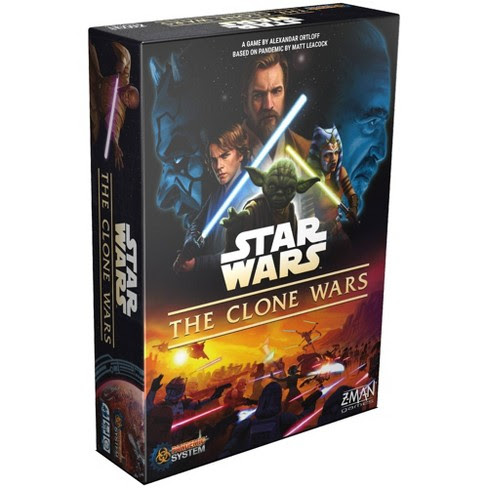
During the New Year’s holiday our family played Star Wars The Clone Wars Game – A Pandemic System Game. It combined our enjoyment of Star Wars and games – and my particular admiration of cooperative games – in an immersive experience ridding the galaxy of battle droids, planetary blockades, and iconic prequel-era villains. The rules and procedures took a little while to understand; various elements draw on the Clone Wars themes, sending players across the galaxy pursing different strategies as turn-by-turn the overall tension increases. Designer Alexander Ortloff adapted elements from Matt Leacock’s innovative Pandemic mechanics to produce a suspenseful and immersive game experience evocative of the Star Wars: Clone Wars cartoon epics.
Tuesday, January 9, 2024
Thursday, January 4, 2024
New Year Blues
“Be at war with your vices, at peace with your neighbors, and let every new year find you a better man.”
– Benjamin Franklin
I enjoy the December holidays with their festive meals, gifts, and occasions to gather with friends and family; but I don’t care much for the far more sobering New Year celebration. Aside from cutting short the yuletide celebrations (those “12 Days of Christmas” that supposedly last until Epiphany), it heaps upon us even more obligations – to reflect on our accomplishments and advancements of the past year, to set goals for ourselves in the new one, to prepare for the austerity, culling, and organizing of the severe winter months – all onerous propositions after such extravagant indulgences of the holidays.
Tuesday, November 7, 2023
Imperfect Information
“Imperfect information is information which in one or more respects is imprecise, uncertain, incomplete, unreliable, vague or partially true.”
– Kayakan & Khanesar*
My recent missive about rumors in roleplaying games started me thinking about imperfect information, both in games and in our real-world experiences. Rumors are, in their own way, uncertain information, especially useful for gamemasters in encouraging characters to pursue opportunities for adventure (or misadventure). Games of all kinds help us learn how to estimate the current situation (or game state) so we can plan and implement responses (often moves or strategies) to alter that situation toward our goal of winning. Not having perfect information allows for more unpredictable variables in our assessments and usually provides a deeper, more challenging (and hence possibly a more satisfying) game experience. Games often provide us learning opportunities in safe-to-fail environments. We deal with incomplete information in our everyday lives, too, whether or not we want to admit it. Learning how to estimate a situation in games, taking into account imperfect information, can help us stumble through the numerous real-life uncertainties we face and decisions we must make.Wednesday, October 25, 2023
Fighters of the Pacific: Aerial Chess
We’re really enjoying Frank Garibaldi and Didier Dincher’s Fighters of the Pacific. After playing a few games against myself to learn the rules, my son and I fought the first two scenarios. At first I was a little intimidated having so many aircraft on the board at once, but I soon realized this was one of the game’s hallmarks. The movement system, with no random elements determining attack success, reflects each aircraft’s strengths (and weaknesses) and really captures the spirit of squadron combat of the period. Fighters of the Pacific plays like “aerial chess” with some basic yet elegant core mechanics that recreate the sprawling dogfights of World War II.
Tuesday, October 17, 2023
An Invitation to Empathy
“empathy: the action of understanding, being aware of, being sensitive to, and vicariously experiencing the feelings, thoughts, and experience of another.”
– merriam-webster.com
Games invite us to put ourselves in someone else’s position. A warlord commanding an army against an identical force (chess). A colonizer of a resource-rich island (Settlers of Catan). Commander of a historical military force (wargames). A specialist fighting diseases spreading through the world’s populations (Pandemic). A fortune hunter exploring underground labyrinths, slaying monsters, and taking their stuff (any number of fantasy roleplaying games). Every game places players in a role within a thematic context; it’s part of their appeal, allowing us to temporarily assume a new, make-believe identity to varying degrees and live vicariously through the game experience. Most games ultimately invite us to empathize with a new viewpoint. As players assessing and responding to evolving game situations within a particular mechanic and thematic context, we have an opportunity to consider a different perspective from our own. Often we play games for the escapist entertainment they offer; but with a little introspection, they can also serve as opportunities to expand our empathy.Tuesday, October 10, 2023
A Comfy Backlog of Gaming
My son and I just got back from a very positive game convention experience – our first together since the seemingly mythical “Before Times” prior to the covid-19 pandemic – and while I’m unpacking things I’m keeping in mind games that engaged him as well as considering a comfy pile of games I urgently want to play when I find the time and/or a willing opponent. Some call this the “Shelf of Shame,” though rather than “shame” I view it as “opportunity.” Have I read all the books in my extensive personal library? No. But they’re available if the urge strikes me or I need to explore some references for a project. I view games the same way. And, of course, the pile isn’t that backlog of hobby game projects (painting minis, working on terrain, etc.) or the other backlog of game design/writing projects. But I like to strike while the iron is hot to engage my son through the intersection of gaming and his (and my) varied interests, such as history and Star Wars. So I’m looking at newly acquired games and how to get them – and my son – to the gaming table.
Tuesday, October 3, 2023
A Character’s Bequest
“A son can bear with equanimity the loss of his father, but the loss of his inheritance may drive him to despair.”
– Niccolo Machiavelli
I’m currently dealing with ongoing in-law drama filling our life with overwhelming anxiety. Games often provide us refuge from real life’s miseries...so I’m channeling my frustration at the onslaught of trust law, inheritance legalities, an uncommunicative and sanctimonious trustee/brother-in-law, and dubious lawyers flooding my consciousness into something productive: writing about heirs and inheritance in roleplaying games. Rules for such things have been little more than a footnote in the earliest games, strange given their emphasis on killing monsters, taking their loot, and amassing incredible fortunes of coin, material, and magic. As games evolved from that model into ones with greater emphasis on characters such concerns seem to have evaporated or become naturally absorbed into more narrative or cinematic game elements. Rather than adhere to rigid rules (or even more liberal “rulings”) about the state of a character’s possessions at their death, such bequests offer rich opportunities to add depth to surviving characters and expand the scope of future adventures with related story elements.
Subscribe to:
Posts (Atom)


