Showing posts with label game design. Show all posts

Tuesday, September 16, 2025

Gaming Great Bridge IV: Playtesting Insights

 “Nine-tenths of tactics are certain, and taught in books: but the irrational tenth is like the kingfisher flashing across the pool, and that is the test of generals.”

— T. E. Lawrence

I’ve been spending time writing down the rules for processes discussed earlier, with an eye to producing both a rulebook for a board wargame and a streamlined player aid format of rules for the event where I expect to run the Battle of Great Bridge game demo. Once I had some firm rules down as a baseline for game play, I devised a gridded map, found some generic pieces to use, and started some self-play testing (with me taking turns running both sides), given my general lack of local players. I made a few adjustments, but overall it seems to deliver the experience I’d hoped to offer: basic rules with player choices, short play time, and all taking into account some historical considerations.

Tuesday, August 5, 2025

Gaming Great Bridge III: Interaction Factors

 “Principles and rules are intended to provide a thinking man with a frame of reference.”

— Carl von Clausewitz

Painting by Glenn Moore depicting
the British attack on the American
breastworks at the Battle of Great Bridge.
Now I’ve transposed the historical battle to the game board, the real challenge begins: determining how players interact with pieces and the map to simulate the engagement. All while keeping my original parameters in mind. In my past talks about historical strategy games I summarized core game processes as “Move, Attack, Morale.” Relying on my earlier research, I set out to define when and how players would command their forces within the framework of a turn sequence...my first design choice challenge.

Tuesday, June 17, 2025

Gaming Great Bridge II: Battle into Game

 “History is the interpretation of the significance that the past has for us.”

— Johan Huizinga

My whiteboard notes on the battle.
With some key considerations to bear in mind I started thinking how to abstract the battle’s historical elements into familiar game forms to simulate the engagement: a board representing the terrain; pieces for military units; and dice, with relevant rules, to adjudicate attack success. I made some general assumptions to make the experience easier for players to understand and enjoy. To do this, however, requires a large degree of abstraction that, with some framing for participants, can help immerse them in commanding forces in the historical battle.

Sources

I have a basic understanding of the Battle of Great Bridge, having lived in Culpeper some 20 years and seen (and read) material about the Culpeper Minutemen. But in designing a streamlined game about it, I needed to ask some questions to adapt the history into a game framework. Most pertain to nearly any battle one seeks to simulate. What did the terrain and troop deployment look like? (Useful for determining the board arrangement.) What forces were involved and how did they compare proportionately in size, number, and capabilities? (Necessary in figuring how many unit pieces to include and ruling how they move and attack.) What ranges and accuracy did Revolutionary war muskets and rifled muskets have? (At the battle the Culpeper Minutemen sent flanking fire into the British from beyond musket range because, as essentially frontier fighters, they used more accurate rifled muskets.)

Tuesday, May 27, 2025

Gaming Great Bridge

 “I set little value upon my health, when put in competition with my duty to my country, and the glorious cause we are engaged in.”

— Lt. Colonel Charles Scott

I am developing a game about the Battle of Great Bridge from the American War of Independence (AWI) and decided I’d keep a design journal, both for my own reference and for others interested in the process I follow in researching and creating a game with specific parameters in mind. I have volunteered to design and run a short participation game at an event this October commemorating the 250th anniversary of the mustering of the Culpeper Minutemen. I’m working under several parameters for this activity as well as bearing in mind a few key issues in the Patriots’ success in the engagement. Although I plan on running the event using a small, wargaming-style diorama map with paper miniatures, I expect I’ll playtest it as a board wargame...and later make it more easily available in that format as a PDF.

Tuesday, February 18, 2025

“Write What You Know”

 “For my part I know nothing with any certainty, but the sight of the stars makes me dream.”

— Vincent Van Gogh

On those rare occasions people ask me for writing advice, I tell them “Write what you know”...and it’s just as valid for game design. It’s one of those trite maxims we parrot as “advice” that, without reflection, means little beyond its superficial simplicity. Yet it’s not an axiom on which to sit complacently, to limit one to writing or designing only based on what they know at that moment. It is a challenge. Write and design what you know...and if you want to work with something you don’t know, strive to know it. Research. The concept is related to another saying worthy of reflection, from Socrates: “The only true wisdom is in knowing you know nothing” (expressed in other times and cultures by various people). And if we know nothing, we must go out and learn something, experience something, so we can draw on that knowledge in our future endeavors...especially activities we do for fun.

Tuesday, June 14, 2022

Rumors in the GM Toolkit

“Half a truth is often a great lie.”

– Benjamin Franklin
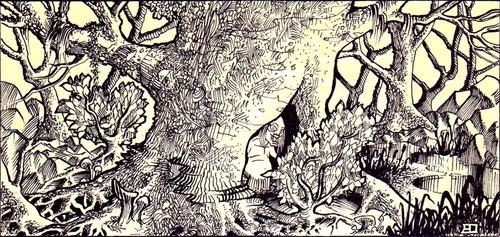
Would you trust any rumors about
this crazy hermit?
One of the first elements of Basic Dungeons & Dragons that impressed me came in module B2 The Keep on the Borderlands. Here, in the supposed base for characters exploring the Caves of Chaos, one could talk to the keep denizens and get information to inspire or aid their adventures...and some of that information was accurate, and some was patently false. I’m developing a new, system-neutral fantasy roleplaying game setting (mostly because, after The Greydeep Marches, I’m a glutton for punishment) and, as I work out key personalities, factions, and locations, I’m tempted to offer a vast menu of rumors to goad characters into exploring different aspects of the region. And I don’t really feel obliged to note which rumors are true and which are false.