
Tuesday, July 26, 2016
WEG Memoirs: The Schedule Boards
Back when I first started working at West End Games the company
maintained a schedule board listing all the products set for
publication in the coming months. The board displayed an impressive
array of products, often two or three each month. The board was
sacrosanct. Moving or, gasp, dropping a product plunged everything
into chaos. Yet it enabled the company to efficiently produce and
publish product to a distribution system and retailer network – and
ultimately to customers – whose revenues enabled the company to
persist. The schedule board demonstrates to me one of the differences
between today’s throng of small-press, independent, and often
single-creator publishers and the few remaining, well-established,
corporate game publishers; one creates for love, the other for money.
 West End’s offices occupied the second floor of an unobtrusive
warehouse on Route 191 north of Honesdale, PA; the infamous Bucci
Imports shoe business used the downstairs offices. Owner Scott Palter
maintained his office on the first floor, but it is here where the
schedule board first resided when I started working there as an
editor in the summer of 1993. The oversized bulletin board contained
an index card for every project in production, arranged beneath the
upcoming 18 months. After a while – I don’t recall how long –
something happened that necessitated the board migrating upstairs
into the West End conference room, where everyone could check it when
needed and passionately debate what titles needed to move for various
reasons that seemed important at the time. No doubt it made more
sense to put it in the meeting room to accommodate the growing ranks
of West End’s editors instead of constantly cramming into the
owner’s office. Staffers hastily covered it up with a sheet when
visitors came to the offices, an extremely rare occurrence.
Tuesday, July 12, 2016
Wargaming with Stars & Crosses

(Note: I know Doug Anderson from various online community interactions focusing on gaming; he provided me a comp download of Stars & Crosses, though I bought a print-on-demand rulebook as physical reference at the game table.)
Tuesday, June 28, 2016
Introducing Newcomers to Games: Theme & Mechanics
Last week’s post about “Attracting Newcomers to Roleplaying Games” inspired me to consider two factors that might influence
people in trying new games. A game’s theme and complexity are
usually topics discussed from the design standpoint: does one start
with a theme and build game rules around it, or does one begin with a
play mechanic and build a themed game around that? Yet theme and the
complexity of mechanics also figure into the conundrum of how best to
introduce people into any games within the adventure gaming hobby.
For beginners – especially complete newcomers – I find an
attractive theme can best engage their enthusiasm to try a game,
while good mechanics (with light yet intuitive complexity) can
provide an enjoyable play experience and bring them back to the table
for a second try.
 For many people a game’s theme initially interests them. Theme
gets players to the table, understandable and engaging mechanics help
transform that theme into a rewarding play experience. For instance,
if I asked a five year-old if he wanted to play a game about hunting
dinosaurs or one with a “push your luck” mechanic, he’s going
to want to play something with dinosaurs; as it happens, these
elements both describe Steve Jackson Games’ Dino Hunt Dice,
yet new players hone in more on the enticing theme than the game
rules.

Tuesday, June 21, 2016
Attracting Newcomers to Roleplaying Games
The recent discussion over at Tenkar’s Tavern and blog posts like Sword Peddler’s about the effectiveness of Free RPG Day
started me thinking once again about how we as gamers, designers, and
publishers can draw newcomers into the adventure gaming hobby. It’s
a tricky gambit considering roleplaying games are still a very niche
hobby, despite popular culture’s general acceptance of Dungeons
& Dragons as a permissible geeky pursuit. Most people still
associate roleplaying game exclusively with D&D without
realizing how many amazing games exist from both established
publishers and innovative individuals, in game stores and online, for
sale and for free. How can we do a better job of sharing our hobby
with curious newcomers?
 Free RPG Day is an organized event meant to promote roleplaying
games. Since it’s run by a game distributor it has the
understandable bias of supporting sales at brick-and-mortar Friendly
Local Game Stores (FLGS) that give them business anyway. Just as a
distributor can’t force a store to conduct business a certain way,
it can only offer unenforceable guidelines on what to do with the
“free” loot provided for this event. Free RPG Day is, as its
organizers freely admit, no longer about introducing newcomers to the
hobby but more about rewarding the hobby’s ardent supporters with
free gaming materials. This effort remains highly dependent on the
FLGS whose facilities and enthusiasm in hosting these events vary
immensely (as well as publishers providing appropriate material).
I’ve heard of stores charging for the free items, hoarding them for
later sale or giveaways, and not participating at all (like the two
closest to me). I’ve also heard great reports of stores with busy
play areas, gatherings of avid fans, and attempts at introducing
newcomers to the hobby with demo games.

Tuesday, June 14, 2016
Artifacts from the Vault of Schweig
I’m culling some of my roleplaying game library and reorganizing
the shelves to put more relevant material in more central areas. In
doing so I uncovered a few intriguing artifacts I often forget about
yet keep for various reasons. Some come from an appreciation of the
designers, others for the significance of the games in the overall
context of adventure gaming’s history. They offer an interesting
window into what engaged me as a gamer over more than 35 year in the
hobby and the diversity of publishing efforts from a variety of
sources.
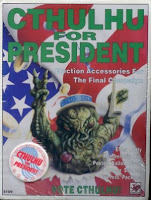 Cthulhu for President Pack: I ordered this by mail way back
in 1992, possibly the first year Chaosium offered it. Despite leaning
in one particular political direction thanks to my wife’s
enlightening influence, I still staunchly believe in the Elder Party
ticket. This packet came with a button, posters, leaflets, Elder
Party membership card, and other goodies. I’m resisting the
temptation to print a slew of flyers to leave around town, but I’m
afraid they’d figure the guy with several Cthulhu-themed t-shirts
and the Cthulhu “fish” on the back of his car was stirring up
trouble....

Tuesday, June 7, 2016
WEG Memoirs: The TORG Map
 |
| West End Games' offices, Honesdale, PA, 1993 |

Tuesday, May 31, 2016
Shields in OSR Games

(Throughout this post I refer to various bonuses to armor class as +1, etc., as I’m using ascending armor class; for the traditional descending armor class read that as -1. Either way, “bonus” means a benefit to armor class in the context of whatever system you’re using.)
I prefer a more heroic style of play rather than the deadly “grinder” style (as I’ve discussed before), so I look to provide my characters with every possible advantage within the bounds of the rules...and then house-rule some mechanics to offer some minor benefits. Of the three characters I’m running through various solitaire scenarios, two have shields and one has eschewed a shield in favor of two-handed weapons (the underpowered battle axe...a topic Jonathan Becker has discussed before at his B/X Blackrazor blog). While one of the shield-bearers has no ranged weapon, the other must set aside her shield if she chooses to use her long bow, temporarily shedding its armor class bonus. I’m examining the shield rules with an eye to making my low-level characters less monster-fodder and slightly more heroic.
Subscribe to:
Posts (Atom)